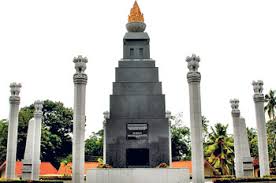
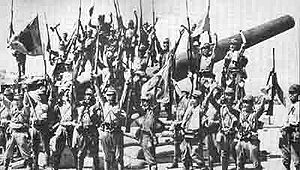
Battery Hearn had been in action firing towards Cavite from
February 1942 and on April 8 and 9, 1942, towards Bataan. This gun emplacement
was captured nearly intact by the Japanese when Corregidor fell and it was
subsequently repaired by them and put back into action. It was, however,
completely neutralized by American aerial bombardment in January and February
of 1945
Battery
Grubbs
(Photo above , courtseyTony Sarao Jan 2013)
Work
on this $212,397 battery started from November 1907 and it saw completion early
in 1909. It was named in honor of 1st Lieutenant Hayden Y. Grubbs who belonged
to the 6th U.S. Infantry and who died during the
insurrection in the islands in 1899.

Battery Grubbs was armed
with two 10-inch guns mounted on disappearing carriages and located well inland
in the west central part of Corregidor. This gun emplacement was intended to
fire to the northwest. At the start of the Second World War the battery was not
originally manned. It was put into active service in early April 1942 but was
quickly knocked out of service and subsequently abandoned.
(Photo above , courtseyTony Sarao Jan 2013)
Notice the ingeneous mechanism which enabled the gun to be lifted
up , it would fire and then be
retracted below the parapet , some-
thing like shown in that famous movie ‘The Guns Of Navronne’’
JAPANESE CAVE IN CORREGIDOR
(Photo above , courtesy Tony Sarao Jan 2013)
A Shinyo ( 震洋) suicide boat cave is clearly visible in the
photograph
Incidentally,
before Corrigedor was captured,the Americans dumped 15,000,000 dollars of pure
silver pieces (at 1941 prices) somewhere in Manila Bay (???!!!)
Topside Barracks
(Photos above , courtsey Tony Sarao Jan 2013)
The ruins of the
world’s longest military barracks, the Topside Barracks which are also popularly
known as the Mile Long Baracks ,due to their
entire length of 1,250 feet or 463.41 meters. A gymnasium, billiard rooms, bowling alley,
swimming pool and barbershop formed part of these famous Barracks during the
pre-war days.
(Photo above, courtesy Tony Sarao Jan 2013)
Also known as the’’ Mile Long Baracks’’
The ‘’Mile Long Barracks’’ during their hey –days , compare the two photographs and you can make out the similarities, though there are no Base-ball players on the ground in front of the barracks now!!
(Photo above-Open source Internet)

(Photo above , courtesy Tony Sarao, Jan2013)
On
29 December 1941, the defenders got their first taste of aerial bombardment on Corregidor.
The attack lasted for two hours as the Japanese destroyed or damaged the
hospital, Topside and Bottomside barracks, the Navy fuel depot and the officers
club. Three days later, the island garrison was bombed for more than three
hours , this is what is left now
CINE’ CORRIGIDOR
To the left at the entrance to the Pacific War Memorial are the
ruins of what used to be Cine Corregidor, a movie theater. It was erected
during the pre-war period to cater to the entertainment needs of the personnel
of the garrison as well as their families.
(Photo above, courtesy Tony Sarao Jan 2013)
Above, Cine Corrigedor today—only memories remain, bombed out during the war
“Cine Corrigedor’’ during it’s
hey days
(Photos above-Open source Internet)
CINE’ CORRIGIDOR
NOW-----
(Photo above , courtesyTony Sarao Jan 2013)
THEN-----
(Photos above-Open source Internet)
(Photo above , courtesyTony Sarao Jan 2013)
Brothers in Arms
This statue is named
"Brothers in Arms" and the plaque in front of it reads, "In
these hallowed surroundings where heroes sleep may their ashes scatter in the
wind and live in the hearts of those who were left behind. They died for
freedom's right and in heaven's sight theirs was a noble cause." It stands
in front of the Pacific War Memorial
Completed in 1968 through the appropriation of the United States Congress, the memorial honors the Filipino and American soldiers who participated in the Pacific War. The main feature of the memorial is the circular altar in a rotunda which symbolizes a wreath of victory. It also has a museum which treasures the relics of the war
Macarthur ‘’Returns-‘’--most
people are not aware that this photograph is not of his return to Corrigidor. He
had actually returned to Leyete island where the American landings took
place and not to Corrigidor where he had uttered those famous words.
(This is a
photograph of the ‘famous photograph’ ,
landing at Leyte —I clicked it from the display in Corrigidor museum)
Lorcha Dock---Departure Point
(Photo above , courtesy
Tony Sarao , Jan2013)
Also called MacArthur's Dock, the Lorcha dock is where locals
believe General MacArthur departed Corregidor from. Before it was renovated , what was left of the old
dock were its ruins – old collapsed wood and concrete – aside from rusted
tracks of an old railway system that once connects Lorcha dock with Malinta Tunnel, bringing personnel and war materials from the
dock to the tunnel.
‘The Army Dock’ or ‘MacArthur’s
Dock’
Or
THE LORCHA DOCK
‘The Army Dock’ and ‘MacArthur’s Dock’ is a small boat pier, it is believed to be the location for the dumping of General
MacArthur’s personal possessions that were left behind after he departed the
island. Ammunition, weapons, desks, chairs, and his entire stock or collection
of prime liquor consisting of over 80 bottles were thrown off this dock. The
condition of most of these items now, 57 years after the fact, remains somewhat
questionable. However, since the bottom here is mostly mud, which acts as a
preservative, chances are good that the bottles remain in very good condition.
Water depth here is only around ten feet.
(Photos above , courtesy Tony Sarao , Jan 2013)
"Sleep my sons, your duty done… for freedom's light has come.
Sleep in the silent depths of the sea, or in your bed of hallowed sod. Until
you hear at dawn the low, clear reveille of God."
He spoke his most famous line "I shall return" after arriving in Australia and not while departing from Corregidor . On 12 March, under cover of darkness, Gen. MacArthur was evacuated from Corregidor on four PT boats for Mindanao, where he was eventually flown to Australia
--- ‘’I shall return’’------famous words and the man was sacked by Truman later !!!!, but that’s another story!!
"We must win. There is no substitute for victory"
CORREGDOR SPANISH ERA LIGHTHOUSE
(Photo above , courtesyTony Sarao Jan 2013)
Then---
(Photos -Open source Internet)
Above,
is a 1945 photo of the battle damaged lighthouse area
Japanese Garden of Peace Park
(Photo above , courtesyTony Sarao Jan 2013)
The Memorial reads : “TRIBUTE TO THE BRAVE. In Remembrance of the 4,500 Fallen Comrades In Arms Of The Japanese Defense Batallaion . . . And Tribute To The Gallantry Of The Filipinos, Americans And Japanese Soldiers Who Fought And Died For A Cause On This Island. MAY THEIR SOUL REST IN ETERNAL PEACE.”
Of the
6000 or more Japanese defenders, about 40 survived in one way or another
Corregidor had 13
anti-aircraft artillery batteries with 76 guns, twenty-eight of which were
3-inch and forty-eight 50-caliber
(Photos above , courtesy Tony Sarao Jan 2013)
Corregidor had 13
anti-aircraft artillery batteries with 76 guns, twenty-eight of which were
3-inch and forty-eight 50-caliber
The Malinta Tunnel is a tunnel complex built by the United States Army Corps of Engineers on the island of Corregidor in the Philippines. It
was initially used as a bomb-proof storage and personnel bunker, but was later
equipped as a 1,000-bed hospital. The main tunnel, running east to west, is 831
feet long, 24 feet wide and 18 feet high. Branching off from this main shaft
are 13 lateral tunnels on the north side and 11 lateral tunnels on the south
side. Each lateral averaged 160 feet in length and 15 feet in width
(Photo above , courtesyTony Sarao Jan 2013)
Booby traps, still live after all these years,
have ensured that on the other side of the debris, these secrets lie inviolate
with the remains of their Japanese guardians. Vehicles, munitions, supplies, five
hundred or more Japanese bodies and a rumored fortune of Corregidor gold still
lie there behind several thousand tons of fallen rock.
Notice--In the photograph
above, I (in bluecap) am standing somewhere near the spot where Macarthur (below) was
clicked sometime in 1945!!!
(Photos above-Open source Internet)
(Photo above , courtesyTony Sarao Jan 2013)
Some of its laterals were so secret only those working there
knew of their existence, and even they were blindfolded to and from each work
shift. When in February 1945 the Japanese exploded the inner laterals of the
top secret Navy Tunnel, they buried forever these tunnels and the secrets they
contained.
(Photos above-Open source Internet)
1942 photo
of men working in one of the lateral tunnels , notice the electric lights
powered from numerous generators supplying electricity to the ‘’ROCK’’
Some of its laterals were so secret only those working there
knew of their existence, and even they were blindfolded to and from each work
shift. When in February 1945 the Japanese exploded the inner laterals of the
top secret Navy Tunnel, they buried forever these tunnels and the secrets they
contained.
(Photo
above , courtesyTony Sarao, Jan 2013)
On one
day Japanese artillery delivered a five hundred pound shell every five seconds
for five hours…3600 shells, enough to fill 600 trucks (they also had 13 air
raids that day as well). It is no wonder that the tunnel systems hold the most
fascination for they are almost the only thing left
(Photo above , courtesyTony Sarao Jan 2013)
(Photos above-Open source Internet)
NOTICE THE TWIN TRAM LINES
VISIBLE AT THE MOUTH OF THE TUNNEL IN BOTH THE PHOTOGRAPHS
Suicide Cliff
(Photo above , courtesyTony Sarao Jan 2013)
Then there is the famous cliff (beyond the railing and to the left) where scores of Japanese soldiers jumped rather than surrender in February 1945.But there is also evidence that this is an concocted story for the benefit of Japanese and other tourists
’There is a limit of human endurance, and that point has long
been passed." ---General Wainwright to President Roosevelt , before he
surrendered
Lt. Gen. Wainwright , May 8, 1944
ISSUE OF TIME (IN CAPTIVITY)
(This is a
photograph I clicked from the display in Corregidor museum)
‘’-----About 2 a.m. a signal rocket burst palely over the fortress island of Corregidor, Japanese batteries which had been shelling the island constantly for seven days, opened up with a new and concentrated frenzy from their positions on the heights of Mariveles. Japanese infantrymen, ferried across the channel by small boats and bamboo rafts, swarmed onto the island's low-lying eastern shore-- - - -‘’
From a radio dugout deep in Corregidor
's rock heart,a boy from Brooklyn tapped out: "Too much for guys to take. . . . They have got us
all...’’
Now to
Subic Bay----
(PHOTOS BELOW BY TONY SARAO)
JAPANESE HELL-SHIPS
SUBIC BAY MEMORIAL
During May
1942 the Japanese began transferring POWs by sea. Similar to treatment on the Death March Bataan
,
prisoners were often crammed into cargo holds with little air, food or water
for journeys that would last weeks.
Many died
due to asphyxia, starvation or dysentery. Some POWs
became delirious and unresponsive in their environment of heat, humidity and
lack of oxygen, food, and water. These unmarked prisoner transports were
targeted as enemy ships by Allied submarines and aircraft
More than
20,000 Allied POWs died at sea when the transport ships carrying them were
attacked by Allied submarines and aircraft. Although Allied headquarters often
knew of the presence of POWs through radio interception and code breaking, the
ships were sunk because interdiction of critical strategic materials was more
important than the deaths of prisoners-of-war
(Photos above , courtesyTony Sarao, Jan 2013)
America , Australia , Britain , China , Czechoslovakia , Denmark ,
Formosa , Holland , India, Indonesia
http://papyrustony.blogspot.in/
"All men are
brothers, like the seas throughout the world; So why do winds and waves clash
so fiercely everywhere?"
--Emperor Hirohito
Finally---
We never know how high we
are, till we are asked to rise
and then if we are true to plan, our statures
touch the skies...
The heroism that we recite would be a normal
thing,
did not ourselves the cubits warp for fear to
be a king.....Emily Dickinson.
Ake Ake Kia Kaha,
And these are photographs---
---------- I TOOK FROM AN ALBUM DISPLAYED IN ONE OF THE MILITARY MUSEUMS IN INDIA . THE ALBUM BELONGED TO A JAPANESE OFFICER WHO WAS KILLED/ CAPTURED IN BURMA IN WW2 . NOTHING MORE IS KNOWN. CAN ANYONE HELP IN TRACING THE SOLDIERS OR THEIR FAMILIES IN JAPAN.THEY HAD FOUGHT FOR THEIR COUNTRY
To the good times!!!
You cannot
choose your battlefield, God does that for you
But you can plant a standard
where a standard never flew: Nathaniel Crane - The Colors


 Sub Khudadad Khan
 The battles on the Western Front in which the Indian Army took part: La Bassee 1914, Ypres 1914-15, Givenchy 1914, Aubers, Bazentin, Morval, Messines 1914, Gheluvelt, Neuve Chapelle, Loos, Delville Wood, Armentieres 1914, Festubert 1914-15, St Julien, Somme 1916, Flers-Courcelette and Cambrai 1917--- ''They shall grow not old, as we that are left grow old:



 ''W
 - ''What struck me about the Gaza War cemetary was not the ‘unlikeliness’ of its tranquility, nor the variety of nationalities and faiths buried there (over 3,600 soldiers of different countries, including India, Egypt, Canada, France, Belgium, Russia, Scotland, England, Greece…), but the craftsmanship of Ibrahim Jeradeh, the 72 year old retired gardener and caretaker who tended and nurtured the cemetery for over 50 years before passing the task on to his sons.''----visitors remarks.